A Recall Buys You a Weekend. The Bad Day Is Still Coming.
A public AI can now find flaws that survived years of expert review. The government's response was to recall one model. That delays the threat — it doesn't remove it. Here's what actually changes for your security program, and the question your board should be asking by Monday.

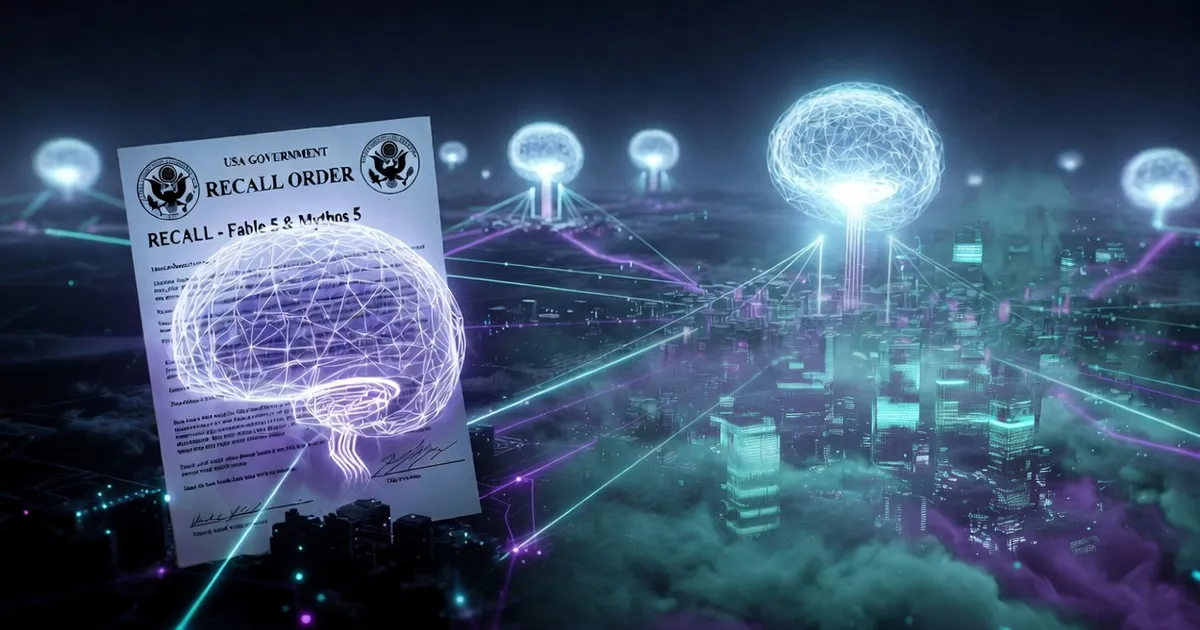
A public AI can now find software vulnerabilities that survived years of expert review. The government's response, today, was to recall one model. That buys a weekend. It does not remove the threat — and it doesn't touch the assumption underneath every security program: that defenders move fast enough to matter.
What happened
At 5:21pm Eastern today, the US government ordered Anthropic to suspend its two most capable models, Fable 5 and Mythos 5, citing a national security concern over their use in cyber operations. Within hours, both were dark for every customer.
The recall isn't the story. Anthropic's defense is. They argued the capability isn't unique to them — equivalent reconnaissance is already available from other public models, used every day by defenders and attackers alike. That's almost certainly true. And it quietly reframes what today actually was: not a threat contained, but a threat acknowledged.
Why it matters
Defense has run on the same clock for twenty years. Detect, triage, respond — before the intruder is through. That clock was set against a human adversary. One that sleeps, second-guesses, and gives up.
Automated reconnaissance resets the clock to zero. It works the whole perimeter in parallel, never breaks concentration, and costs about what a mid-tier SaaS seat does.
So here's the sentence to bring to your next staff meeting:
If a public AI finds flaws that survived years of expert review, you're no longer competing on speed. And every plan that assumes you can respond faster than the attacker is already a losing plan.
Detect-and-respond won't fail with an alarm. It degrades silently. The first proof you get that the clock ran out is the incident itself.
What changes — and what doesn't
The recall changes one thing: it pulls a single vendor's model for a while.
Your exposure is exactly where it was this morning. Take Fable away, and the same capability walks back in behind the next model an attacker loads. Constrain one lab, and it ships from a jurisdiction the order can't reach. This isn't a tool anymore; it's a commodity — and commodities don't recall cleanly.
That's why the recall is a delay, not a defense. Anthropic already expects to restore access. Fable may be back before this story leaves your feed. Banning a model treats the symptom and renames the disease.
So you're choosing between two operating models, whether you've named the choice or not.
The first keeps faith with the clock: more sensors, more analysts, a wider net, all wagered on out-pacing something that doesn't tire. Every model release shortens your lead. Eventually the lead is gone, and you learn that the hard way.
The second stops playing the clock entirely — because the attacker's reconnaissance returns an empty set. You can't probe an endpoint that isn't listening. You can't enumerate a credential that was never standing. Capability becomes moot when there's no target to point it at. This is the direction the spend is already turning: Gartner has half of enterprise security budgets moving to preemptive approaches by 2030. Today is that forecast showing up ahead of schedule.
What you do about it
Quit racing the attacker's tools, and quit waiting for Washington to confiscate them. Change what the attacker can see instead.
That's what LayerV does. We make infrastructure undiscoverable, so capability — whoever's wielding it, whatever's been banned — finds nothing to work with. Endpoints don't sit exposed waiting to be found; access opens only after identity is proven through the IdP you already run, lasts exactly one session as a single-use qURL™, and closes behind the user when they leave. It operates at the protocol layer on the open OpenNHP standard from the Cloud Security Alliance, aligned with NIST 800-207. The adversary's opening move — look around, see what's here — comes up blank, because there's nothing on the map to begin with.
The board question this week isn't which models are safe right now. It's this:
When the recall lifts and the next model ships, are we ready for the bad day — or still wagering we can outrun a machine?
If that answer makes you wince, it's worth fifteen minutes.
Take the Next Step
- Get Mythos ready — the readiness playbook and five-question self-test
- Book a 15-minute executive briefing — the business case for invisible infrastructure
- Install the qURL CLI — publish a resource and share a private link in minutes, free
- Read how it works — the technical deep dive
A recall expires when the directive lifts. Being invisible doesn't.