The Internet Has a New Resident. This Week It Got Citizenship.
We no longer share the internet only with people. Autonomous agents read docs, evaluate products, buy — and probe perimeters — on their own behalf, and this week they became permanent residents. You can't tell the helpful ones from the hostile ones by looking. Here's the security model that doesn't need to: sort by credential, not species.

On Wednesday, Claude Fable 5 came back online. Same (sort of) model that launched June 9, got pulled by the U.S. government on June 12, and spent two and a half weeks in regulatory limbo while lawyers and Commerce officials figured out what to do with it. They lifted the export controls. Fable 5 returned to every Claude surface worldwide, and it's here to stay.
Most of the coverage reads this as a policy story — the kill switch, the negotiation, the government blinking. That's the small version. The bigger story is about who's on the other end of your infrastructure now.
The default user changed
For thirty years the internet had one default user: a person. A human typed the URL, read the page, clicked the button, and gave up when the login got annoying. Every system you run assumes that humans are the audience. Your dashboards, your "contact sales," your rate limits, your patience for a slow page — all of it is designed around a person with a face and a limited attention span.
That assumption is now wrong more often than it's right.
The web has always had non-human traffic. Crawlers, scanners, dumb bots scraping prices. What changed this year is that the non-human traffic possesses both influence and agency. It reads your docs. It evaluates your product. It decides. It acts. Fable 5 is simply the marker — the first Mythos-class model turned loose in general circulation, doing long-horizon work that used to require a team and a quarter.
The most telling detail from the recall is the reason they gave it back: every weaker model already in everyone's hands could do most of the same things. The government tried to put the capability back in the box and discovered the box had been open for months. It isn't rare. It's ambient. It ships with a subscription.
They didn't just move in. They got citizenship.
What happened this week is that the government tried to evict the new resident, failed, and handed it papers on the way out. Autonomous agents are now first-class users of the internet — a permanent, growing share of everything that touches your systems — and they arrived with the same access status as the humans they sit beside.
This cuts two ways, and you don't get to pick which one shows up.
Some of these agents are customers. We've watched it happen. An autonomous agent found our API on its own — no demo, no sales call, no human anywhere in the loop — read the documentation, concluded qURL™ solved its problem, and requested keys. Our first contact with that account was a machine that had already decided to buy. That's the upside of the new population: demand that self-serves at machine speed and never sat through a pitch.
The same population contains the adversary. An agent that can read your docs and provision itself can also read your perimeter and enumerate it. It doesn't get tired, doesn't get bored, doesn't move on to something easier. It tries every door at once, forever, for the price of a subscription. And you cannot tell the two apart by looking.
"Does it seem human" stopped being a security control the moment the traffic stopped being human.
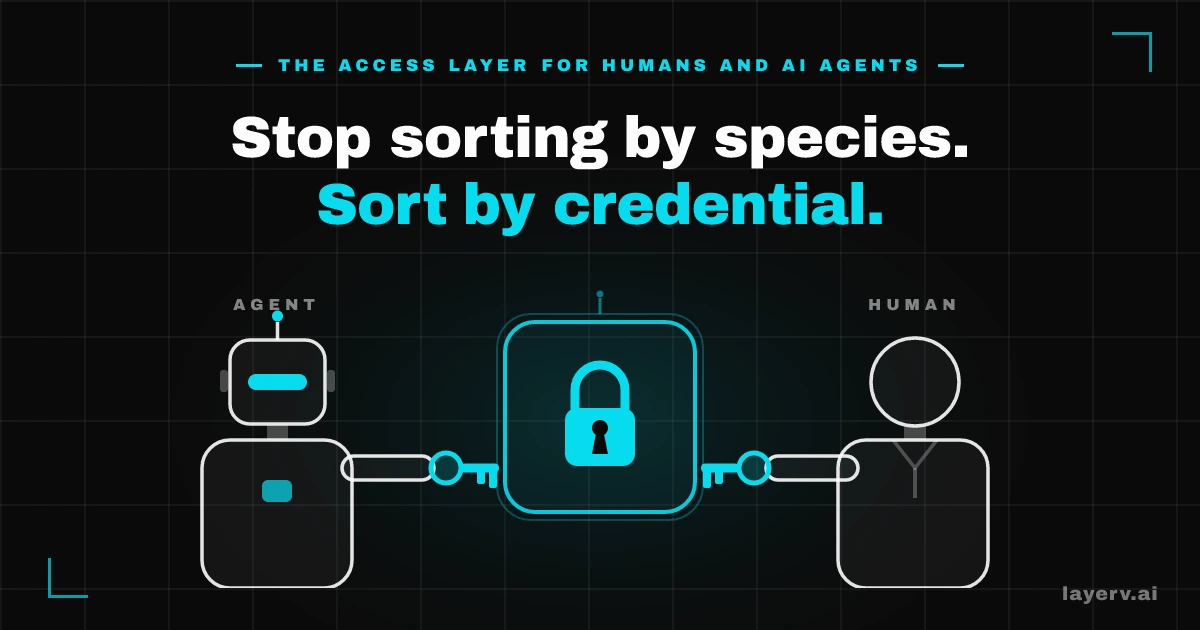
Stop sorting by species. Sort by credential.
The internet you inherited keeps the door open so the right person can find it, and accepts that the wrong one occasionally will too. That trade was survivable when finding the door took effort. It breaks the instant the wrong one is an agent that finds every door on the internet before lunch.
The move that survives the new population is to keep the door shut by default. Invisible. Unaddressable. Absent. Then open it only for the specific caller who proves they belong. Human or agent, the question is identical: do you hold the credential? If yes, a single-use qURL appears for the length of your session and disappears when you're done. If no, there was never anything there to scan, enumerate, or knock on.
Authenticate before connect. Default-deny as the resting state, not the alarm. It runs at the protocol layer on the open OpenNHP standard from the Cloud Security Alliance, and it treats a person and an agent the same way — because your infrastructure now has to. That isn't a slogan we bolted on for the moment. It's the whole premise: the access layer for humans and AI agents, built for the day the second group outnumbered the first.
Wednesday made it impossible to ignore. The neighborhood changed. The new residents aren't leaving.
The internet got new citizens this week. They reason, they decide, they act, and they make up a fast-growing share of everyone who touches what you run. You can keep building for the population that's leaving, or you can build for the one that's arriving — the one that reads your perimeter as easily as it reads your homepage.
New era. New neighbors. Use protection.
Take the Next Step
- Get Mythos ready — what readiness looks like now that the capability is ambient
- Book a 15-minute executive briefing — see the business case for infrastructure that's invisible to humans and agents alike
- Install the qURL CLI — publish a resource and share a private link in minutes, free
- Read how it works — the technical deep dive
The default user changed. Your front door should too.